



Which Stoiq Carry-On Bag Fits Your TSA Quart-Size Packing Needs?
If you need a carry-on solution that compresses your clothes and dodges checked-bag fees, the Stoiq Carry-On Solution 20L works best for weekend trips, while the Stoiq Carry-On Solution 25L handles a week or more. Both use a built-in USB-C rechargeable pump, fit standard U.S. carry-on cavities, and let you skip the $35 to $75 checked-bag fee most airlines charge. The catch: compression shrinks volume, not weight, so a jam-packed bag can still trip a scale.
- Weekender travelers: Go with the 20L for a 3 to 4-day trip.
- Week-long travelers: Go with the 25L, but weigh your packed bag before you leave the house.
Key Takeaways
| Point | Details |
|---|---|
| Choose by trip length | Pick the 20L for weekend trips and the 25L for week-long or bulky-gear travel. |
| Volume shrinks, weight doesn’t | Compression saves space but never changes what the airline scale reads. |
| Match pump to travel style | Rechargeable pumps suit single-destination trips; roll bags suit frequent repackers. |
| Confirm TSA and airline rules | Small USB-C pumps typically clear screening, but airline weight limits still apply. |
| Stoiq bags simplify the process | The Stoiq 20L and 25L integrate the pump directly into the bag, backed by over 20,000 users. |
Where to Verify the Details Before You Fly
- Sandmarc vacuum compression bag review
- Travel + Leisure’s vacuum bag testing
- Wireless pump vs manual comparison
Always confirm final screening and weight rules on the TSA and your specific airline’s website before departure.
Table of Contents
- Why a Tsa Quart Size Bag Compression System Actually Helps
- How Vacuum Compression Bags Work and What Types Exist
- What Should You Check Before Buying a Compression Bag?
- How Do You Pack and Compress a Carry-On Bag Correctly?
- What Size Stoiq Bag Fits Your Carry-On?
- Are Compression Bag Pumps Allowed Through TSA Screening?
- Why the Stoiq Carry-On Solution Fits U.S. Travel Needs
- Manual Roll Bags or Rechargeable Pumps: Which Wins?
- Ready to Pack Smarter for Your Next Flight?
- Sources
Why a Tsa Quart Size Bag Compression System Actually Helps
Vacuum compression frees up carry-on volume, which means you can consolidate two bags into one and avoid gate-check or checked-bag charges entirely. That’s the real payoff for U.S. travelers juggling airline size limits.
Testing on rechargeable pump kits found that compression regularly cuts folded clothing stacks to roughly half their original height, and broader roundups peg typical volume reduction between 40% and 60%, with some setups claiming more under ideal conditions according to Travel + Leisure’s comparison testing. None of that changes what the scale says. A vacuum-sealed bag full of wool sweaters still weighs the same as it did loose in your closet.
Pro Tip: Pack your heaviest items, like jeans and boots, near the wheels of your carry-on before you compress everything else. It keeps the bag balanced and stops the compressed brick from shifting mid-flight.
How Vacuum Compression Bags Work and What Types Exist
These bags remove trapped air from between fabric fibers, shrinking the space clothes occupy while leaving their mass untouched. Squeeze the air out, and a pile of clothes that took up a third of your suitcase suddenly fits in a corner.
Three main types dominate the market:
- Roll and press bags: No pump required, you manually roll out air, best for quick mid-trip repacks.
- External vacuum-compatible bags: Work with a household vacuum cleaner, deliver strong suction but require a separate device.
- Rechargeable pump systems: Built-in or included USB-C pumps, deliver consistent results without lugging extra gear.
Materials matter more than most buyers expect. Multi-layer PA and PE construction or reinforced nylon resists punctures far better than the thin plastic used in cheap roll bags, a distinction confirmed by testing on cordless electric pump systems.
What Should You Check Before Buying a Compression Bag?
Before you buy, confirm these specifics rather than trusting a product photo. The non-negotiables: usable liters or dimensions, compressed thickness once sealed, pump type, battery details, valve and zipper durability, and warranty coverage.
One clarification worth making here: this guide treats “quart-size bag” as a vacuum compression kit for clothes, not the small clear liquids pouch the TSA requires at security. You’ll still need a compact toiletry bag for that separately.
- Rechargeable pump: Best if you repack multiple times per trip and want speed over manual effort.
- Roll-type, no pump: Best if you make frequent short stops and don’t want to manage a battery.
- Reinforced double-zip seals: Look for these if you’re traveling more than a week, since long-term testing shows cheaper single-zip bags leak air over months of use.
- Warranty length: A limited lifetime warranty signals the maker expects the seams and valve to survive years of travel, not just one trip.
Pro Tip: Test seal quality at home before your trip. Compress a bag full of towels, measure its height, then let it sit overnight. If it’s noticeably taller by morning, the seal is leaking and you need a different bag.
How Do You Pack and Compress a Carry-On Bag Correctly?
Consistent results come down to sequence, not luck. Follow these steps every time and you’ll get the same compressed thickness trip after trip.
- Lay the bag flat and load garments in loose folds rather than tight rolls.
- Distribute weight evenly across the bag’s width.
- Zip the seal completely, checking for a clean track with no fabric caught in the teeth.
- Attach the pump to the valve and power it on.
- Extract air until the bag stops shrinking, usually 20 to 40 seconds.
- Detach the pump and press-check the seams for any air leaks.
- Stow the compressed bag flat against the hard side of your suitcase.
Pro Tip: Keep sharp items like belt buckles and shoe heels away from the seams. A stray buckle pressed hard against a seal during compression is the most common cause of a punctured bag.
What Size Stoiq Bag Fits Your Carry-On?
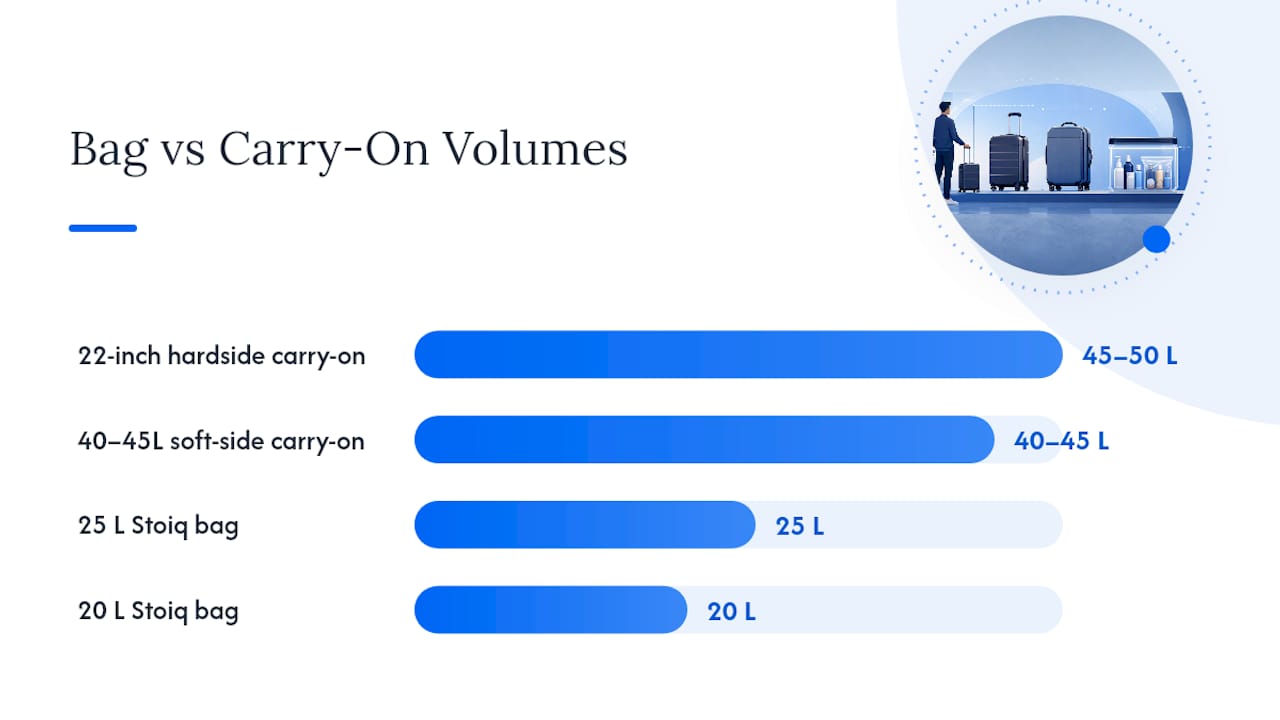
Pick a usable capacity that fills at least one full side of your suitcase, so the compressed brick stacks flat instead of leaving awkward gaps. A 20L bag suits a standard 22-inch carry-on (roughly 45 to 50 liters total), while a 25L bag suits larger 40 to 45L soft-sided carry-ons or a personal item plus overhead combo.
| Bag Size | Typical Carry-On Fit | Example Packed Load |
|---|---|---|
| 20L | 22-inch hardside carry-on | 5 pairs of jeans or a 3-day mixed outfit set |
| 25L | 40 to 45L soft-side carry-on | 3 puffer jackets or a week of casual clothing |
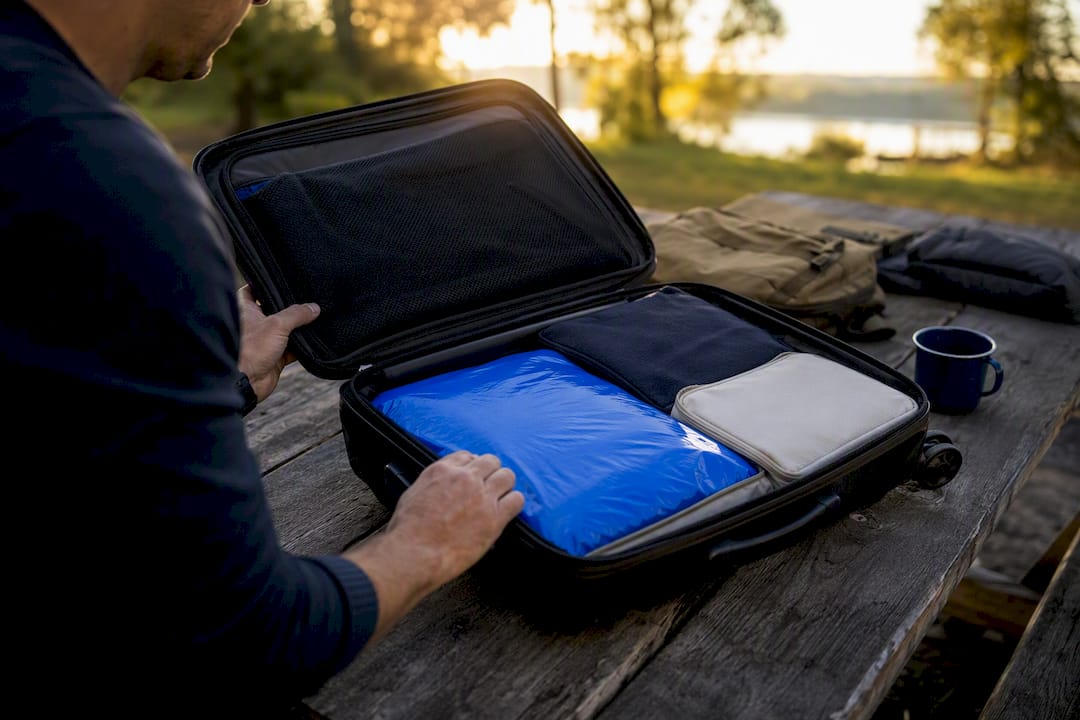
Compressed thickness changes how you should orient the bag. A flatter, wider brick stacks better against a suitcase’s hard back panel, while a thicker one works better standing upright along a sidewall.
Are Compression Bag Pumps Allowed Through TSA Screening?
Most small USB-C travel pumps included with compression kits are allowed through TSA screening, but you should still confirm your specific pump’s battery details and check your airline’s carry-on policy before you fly.
- Keep the pump accessible in case an officer wants to inspect it separately from your bag.
- If TSA needs to open a sealed compression bag, expect them to reseal it manually, not with your pump.
- Compressed volume doesn’t exempt you from airline weight limits, so weigh your bag regardless of how flat it packs.
- Check Stoiq’s own breakdown of TSA rules for compression bags and your airline’s site before departure.
Lithium battery pumps in these kits typically run small, low-capacity cells well under the watt-hour thresholds that require special handling, but airline policies can still vary slightly.
Why the Stoiq Carry-On Solution Fits U.S. Travel Needs
The Stoiq Carry-On Solution 20L and 25L are built around a simple idea: pair a compression bag with its own pump so you never need a separate vacuum device. That single design choice removes the biggest friction point in vacuum packing.
- Best for: 20L suits weekend and 3 to 4 day trips; 25L suits week-long trips or bulky winter gear.
- Pump type: Built-in USB-C rechargeable pump on both models.
- Materials: Reinforced multi-layer construction designed to resist punctures during repeated compression cycles.
- Support: Backed by Stoiq’s warranty and customer support.
Stoiq’s product pages describe the integrated pump as eliminating the need to carry a separate vacuum device entirely, a detail borne out by feedback from more than 20,000 Stoiq customers who’ve used the compression bags across real trips.
Manual Roll Bags or Rechargeable Pumps: Which Wins?
Manual roll bags win when you repack constantly and want zero battery dependence. Rechargeable pump systems win when you want deep, consistent compression for a single destination or bulky winter gear.
- Compression depth: Pump systems compress deeper and more evenly than manual rolling, according to comparative testing on wireless pump systems.
- Repack speed: Roll bags win for quick, no-charge repacks between hotel stops.
- Durability: Reinforced valve pump systems tend to hold their seal longer than basic roll-and-clip designs.
If you’re bouncing between three cities in five days, pack a roll bag. If you’re settling into one destination with a suitcase full of ski gear, the pump system earns its keep.
A Traveler’s Quick Take on Choosing a Compression Bag
I pick the 20L for short trips and the 25L for anything over a week, because the extra five liters covers a jacket or extra pair of shoes without forcing a second bag. My habit: pack at home, charge the pump the night before, and test the seal once before I leave. It takes five minutes and saves a repacking headache at the gate.
Ready to Pack Smarter for Your Next Flight?
Stop juggling separate vacuum pumps and bulky compression cubes. The Stoiq Carry-On Solution 20L and 25L fold the pump directly into the bag, so you compress and repack anywhere with an outlet or a charged battery, no separate device required.
Before you buy, check the product page for your exact carry-on cavity size, current warranty terms, and any active bundle pricing, since pairing a compression backpack with a 25L bag often costs less than buying each separately. Head to the Stoiq Carry-On Solution 20L page now to compare sizes and pick the one that matches your next trip.
Sources
- Sandmarc vacuum compression bag review — The Strategist (New York Magazine)
- The best travel vacuum bags (Travel + Leisure)
- Wireless pump vs manual vacuum bags for travel (Travel Inspira)
- Travel vacuum bags with cordless electric pump review (Nordic Design Blog)
