



Pack Smarter: Build a Travel Capsule Wardrobe That Works
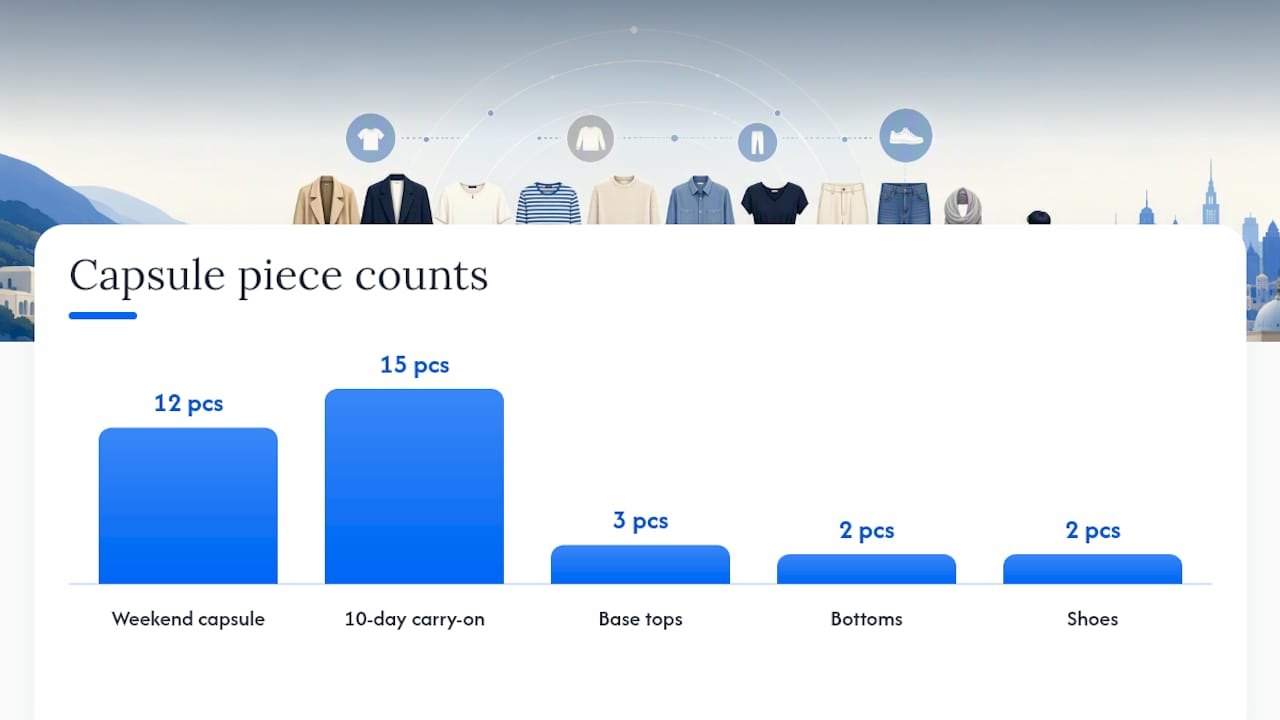
A travel capsule wardrobe of 12 to 15 pieces, built around one color palette, gets you through almost any trip without checking a bag. Use 12 pieces for a long weekend or a week-long trip with no laundry stop. Use a small extended set for about ten-day trips where you plan one mid-trip wash. Either way, three rules hold: stick to a single coordinated palette, choose rewearable fabrics that hide odor and dry fast, and pack to fit a carry-on before you buy anything new.
Here’s why this works so reliably: a small set of pieces in one palette produces far more outfit combinations than the piece count suggests, and pairing that with a simple laundry cadence means you’re never actually short on clean clothes.
Three rules to build around:
- One palette: three neutrals plus one accent color, so every top pairs with every bottom.
- Rewearable fabrics: merino wool, technical blends, and quick-dry cotton over anything that wrinkles or holds odor.
- Carry-on first: design the wardrobe to fit a single cabin bag and personal item, not the other way around.
Key Takeaways
A 12 to 15 piece travel capsule wardrobe built on one color palette and rewearable fabrics reliably covers trips from a long weekend to 10 days without checking a bag.
| Point | Details |
|---|---|
| Match count to laundry, not days | Use 12 pieces with no wash planned, 15 pieces if you’ll do one mid-trip wash. |
| Lock the palette first | Three neutrals plus one accent color lets every top pair with every bottom. |
| Prioritize merino and quick-dry fabrics | Choose fibers that resist odor and dry overnight after a sink wash. |
| Limit shoes to a couple of pairs | Wear the bulkiest pair on travel day and pack one lighter alternative. |
| Save compression bags for bulky soft items | Reserve vacuum compression for coats and knits, not structured blazers. |
Table of Contents
- How Many Pieces? Choosing Counts By Trip Length
- Choosing A Palette And Assigning Each Piece A Job
- Fabric And Fit: Packing For Rewearability
- Shoes And Accessories That Multiply Your Outfits
- Packing And Folding: Fitting 12 To 15 Pieces In A Carry-On
- Copyable Sample Capsules For Warm, Cool, And Business Trips
- When Compression Gear Actually Helps A Capsule Wardrobe
- Where To Learn More About Capsule Packing
- What Most Packing Advice Gets Backward
- Sources
How Many Pieces? Choosing Counts By Trip Length
The right number of pieces depends less on how many days you’re gone and more on how many days pass between laundry loads. That distinction changes everything about how you plan.
- A small capsule works for short trips of just a few days where you won’t do laundry at all. This is the minimalist packing list at its leanest, built for a weekend conference or a quick family visit.
- 12 pieces is the standard for a long weekend or a week-long trip. It’s flexible enough to cover a mix of casual days and one nicer dinner, and it’s the count most capsule wardrobe guides point to as the sweet spot for carry-on travel.
- 15 pieces covers 8 to 10 days when you build in one mid-trip wash, whether that’s a hotel laundry service or a sink wash the night before you need clean shirts again.
The math behind this is more generous than it looks. Three tops, two bottoms, one smart shirt, one extra layer, and two pairs of shoes already gives you roughly 12 distinct outfit combinations before you touch an accessory. Add a scarf or a belt and the perceived variety multiplies again, even though you haven’t added a single piece of clothing.
Before you settle on a count, run through this checklist:
- What are you actually doing each day? Hiking and museum hopping need different bottoms than back-to-back meetings.
- How dressed up does the trip get, and how often? One event usually needs one smart outfit, not three.
- Are you willing to hand-wash a shirt in a sink, or do you need a full 15-piece buffer instead?
Choosing A Palette And Assigning Each Piece A Job
Every piece in a capsule wardrobe for travel needs a job, and the job only works if the palette is locked down first. The standard formula is three neutrals plus one accent: think navy, stone, and white with a tobacco brown accent, or charcoal, cream, and olive with a burgundy accent for cooler climates. Warm-weather trips lean toward lighter neutrals like sand and white; cooler trips lean toward charcoal and navy, which hide travel grime better anyway.
Once the palette is set, assign each piece a slot instead of buying at random:
- Base tops: three or four tees or tanks that layer under anything.
- One smart shirt or blouse: the single highest-leverage piece in the whole wardrobe, since it lets a casual outfit slide up to dinner-appropriate in seconds.
- Bottoms: two pairs, one structured, one relaxed.
- Outer layer: one packable jacket or cardigan that works over every top.
- Shoes: covered in detail below.
- Accessories and foundations: the small pieces that change how an outfit reads without adding bulk.
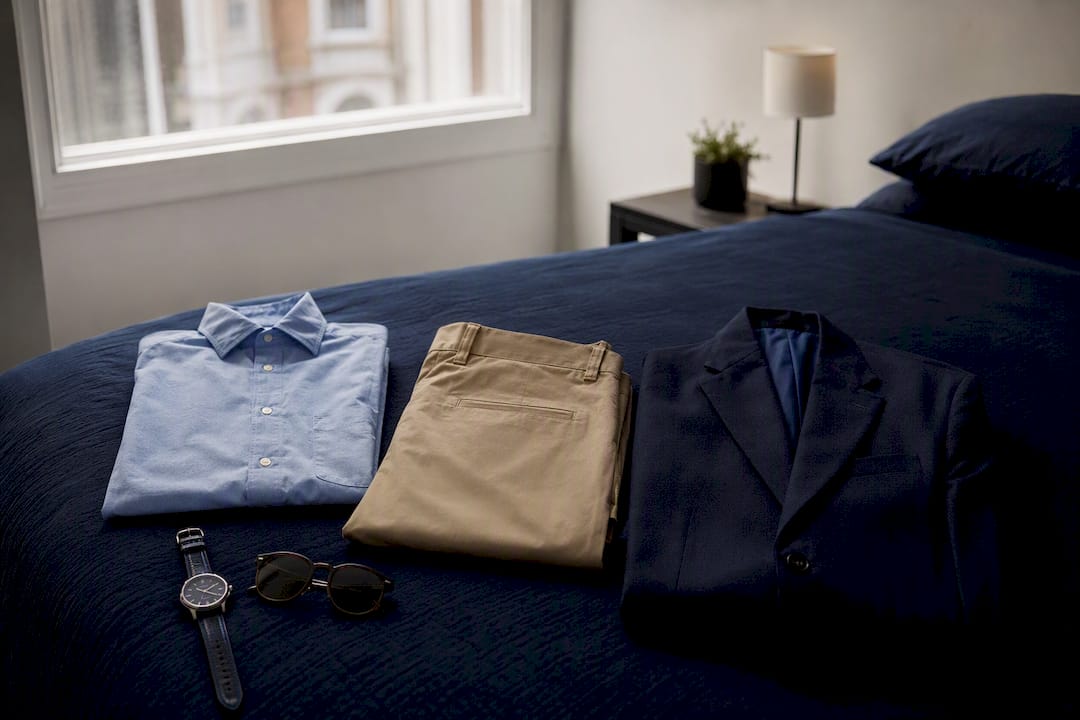
Pro Tip: Lay every piece out on the bed before you pack and ask one question per item: does this pair with at least three other pieces in the pile? If the answer is no, it doesn’t make the cut, no matter how much you like it.
That single smart shirt is worth dwelling on. It’s the piece that does the most work in the entire capsule, because it’s the difference between “packing for a business trip” in the narrow sense and packing a wardrobe flexible enough to move from a client meeting to a casual dinner without a second thought.
Fabric And Fit: Packing For Rewearability
Fabric choice determines whether a 12 to 15 piece wardrobe actually survives a week of wear, and this is where most first-time minimalist packers get it wrong. Merino wool is the standout recommendation across most packing guides for a reason: it resists odor for multiple wears, regulates temperature in both directions, and packs down small without deep wrinkling. Technical blends built for travel do a similar job at a lower price point.
For hot climates, linen and lightweight cotton earn their spot because they breathe and dry quickly after a sink wash, even if they wrinkle more than merino. The tradeoff is worth it when the alternative is overheating in a synthetic blend.
Fit matters as much as fiber. Structured pieces, blazers with shoulder padding, stiff dress shirts, thick denim, should be limited to one per trip at most, because they don’t compress well and they don’t flex across casual and formal settings the way an unstructured knit blazer does. If a trip genuinely needs tailoring, pack one unstructured jacket that can be dressed up or down rather than a true suit jacket.
Care routine ties it together:
- Hand-wash in a sink with a small packet of travel detergent, then roll in a towel to press out water before hanging.
- Choose pieces explicitly labeled quick-dry or merino when shopping for the trip, not just when packing for one.
- Hang damp items near airflow overnight rather than draping them flat, which slows drying time significantly.
Shoes And Accessories That Multiply Your Outfits
Shoes are the heaviest, bulkiest items in any carry-on, which is exactly why the rule here is strict: two pairs, occasionally three if a trip genuinely spans hiking and formal dinners. Wear the bulkiest pair on travel day so it never takes up bag space at all.
The most common combination that works across trip types is a comfortable sneaker for walking days paired with a dressier flat or minimal leather shoe for evenings. Sandals swap in for the sneaker on beach or tropical trips.
Accessories are the cheapest way to expand a wardrobe without adding weight:
- A belt in a color that matches both neutrals ties bottoms and tops together instantly.
- A scarf changes the entire look of a base tee and doubles as a blanket or head covering on flights.
- Compact jewelry, one or two pieces, adds polish to the smart shirt for evening.
Tech and toiletries don’t count against your capsule piece total since they live in your personal item, not your clothing bag. Keep a compact charger, one universal adapter, and a toiletry bag with solid or travel-size liquids separate from the wardrobe planning entirely, so packing math for clothes stays clean.
Packing And Folding: Fitting 12 To 15 Pieces In A Carry-On
Getting a well-planned capsule wardrobe into an actual bag comes down to sequence, not luck. Follow these steps in order and the process gets faster every time you repeat it.
- Wear your bulkiest items on travel day. That means the heaviest shoes, the thickest jacket, and any bulky accessories, worn rather than packed.
- Load shoes first, at the base of the bag, stuffed with socks or a charging cable to hold their shape and use dead space efficiently.
- Sort clothing into two packing cubes: one for tops and one for bottoms and layers, so you’re never digging through the whole bag to find one shirt.
- Fold structured pieces, roll the rest. Rolling works well for tees, base layers, and anything knit; folding protects structured shirts and the one blazer from creasing along a roll line.
- Keep your toiletry bag near the top or in a separate compartment so it doesn’t dig into your wardrobe pile every time security wants a liquids check.
- Pack liquids and quick-access items last, right at the top, so airport security checks don’t mean unpacking your whole capsule.
Packing cubes improve organization and packing speed noticeably over loose packing, and they’re the right tool for most of a capsule wardrobe. Compression bags earn their place for a narrower job: bulky soft items like a puffer jacket, a wool sweater, or extra layers for a cold-climate trip, where squeezing out trapped air can meaningfully shrink the footprint. They do far less for structured garments like blazers or stiff denim, which resist compression and can crease under pressure.
Before you zip anything shut, check your airline’s cabin bag dimensions. Most carriers cap carry-ons around 22 x 14 x 9 inches and personal items separately, and gate agents increasingly measure bags at boarding when overhead space runs tight. A carry-on-focused packing approach built around these limits from the start avoids the stress of a last-minute repack at the gate.
Copyable Sample Capsules For Warm, Cool, And Business Trips
Here’s a 12-piece weekend capsule built on a navy, stone, and white palette with a tobacco accent, workable for warm or cool climates depending on fabric choice:
| Slot | Warm-weather pick | Cool-weather pick |
|---|---|---|
| Base tops (x3) | Cotton tees, white and stone | Merino long-sleeve tees, navy and stone |
| Smart shirt | Linen button-up, white | Merino button-up, navy |
| Bottoms (x2) | Chino shorts, stone; linen pants, navy | Chinos, navy; dark denim |
| Outer layer | Lightweight cotton overshirt | Packable merino cardigan |
| Shoes (x2) | Canvas sneakers; leather sandals | Leather sneakers; suede loafers |
| Accessory | Tobacco leather belt | Tobacco leather belt |
For a 15-piece, 10-day carry-on capsule, add one extra base top, one extra bottom, and plan a mid-trip wash around day 5 or 6. A sample rotation might run: Day 1 travel outfit worn on the plane, Days 2 to 4 rotate tees with both bottoms, Day 5 wash night, Day 6 repeat the rotation with the smart shirt swapped in for a dinner out, Days 7 to 10 continue the rotation using the now-clean pieces from day one.
The business-travel variant slots in just one smart outfit, a blazer or structured shirt with matching trousers, and builds the rest of the business trip packing list around casual pieces that still read as professional-adjacent: a merino polo, well-fitted chinos, one pair of clean sneakers. That single formal outfit covers meetings while the rest of the trip stays comfortable and reusable.
When Compression Gear Actually Helps A Capsule Wardrobe
A well-planned capsule wardrobe already solves most of the space problem. Compression tools solve what’s left: the bulky items that resist folding no matter how disciplined your piece count is. A vacuum-sealed bag with a built-in pump, like the ones Stoiq makes, removes trapped air from soft bulky items and can meaningfully increase the usable volume of a carry-on, according to the company’s own comparison of compression bags and packing cubes. Stoiq cites more than 20,000 travelers who’ve used the built-in pump system instead of carrying a separate vacuum device.
Compression earns its keep in specific situations:
- Bulky seasonal outerwear, like a winter coat or a puffer jacket, that would otherwise eat half a carry-on.
- Multiple knit layers packed for a trip that swings between warm days and cold nights.
- Soft goods generally, towels, extra bedding for a long stay, anything without rigid structure.
Pro Tip: Don’t compress your one blazer or structured shirt. Vacuum pressure can set creases into stiff fabric that a steamer won’t fully lift, so keep structured pieces folded flat in a packing cube instead.
Where To Learn More About Capsule Packing
- Travel Capsule Wardrobe Guide: the source behind the 12 to 15 piece framework and combination math used throughout this guide.
- Carry-On Packing Walkthrough: step-by-step rules for fitting a capsule into a single cabin bag.
- Streetwear Capsule Starter Guide: a 12-piece approach with styling formulas for readers who want a different aesthetic angle.
- How to Pack for 2 Weeks in a Carry-On: Stoiq’s own extended-trip packing walkthrough.
What Most Packing Advice Gets Backward
Most packing guides treat piece count as the whole answer, as if landing on “12” or “15” solves the problem. It doesn’t. The count only works because of the laundry plan and the palette discipline sitting underneath it, and most advice buries those two things as footnotes instead of leading with them.
The overlooked piece is that single smart shirt. Readers fixate on shoes and jackets, but one well-chosen shirt is what lets a casual capsule cover a nice dinner without adding a single extra item. Skip it, and you’re back to overpacking “just in case.”
If you take one thing from this guide, let it be this: build the palette and the laundry plan before you buy anything. The piece count follows naturally once those two decisions are locked. Gear like compression bags helps at the margins, but it never fixes a wardrobe that wasn’t planned around rewearability from the start.
— Hugh
Sources
- Travel Capsule Wardrobe (2026 Guide) | Capsule Wardrobe AI
- How to Pack a Travel Capsule Wardrobe (Carry-On Only)
