



Compression Cubes vs Packing Cubes: Which Wins Your Carry-On?
If you fly carry-on-only, compression cubes usually win. If you’re hopping between three cities in five days and living out of your suitcase, plain packing cubes usually win. The difference comes down to a trade-off: compression cubes buy you roughly 20 to 30 percent more usable space by squeezing air out of soft garments, while standard cubes buy you speed and structure through a single zipper and no straps to wrestle with.
Neither tool is “better” in a vacuum. The right pick depends entirely on your trip:
- Carry-on-only flights, one hotel: compression cubes, because every cubic inch counts and you’re not repacking daily.
- Multi-city or backpacking trips: plain packing cubes, because fast access beats maximum density when you’re in and out of a bag every morning.
- Bulky winter gear or long hauls where checked-bag fees loom: an integrated vacuum system pushes space savings even further, at the cost of needing a pump.
The evidence and the packing technique behind that verdict follow below.
Key Takeaways
Compression cubes save more space than packing cubes, but packing cubes offer faster access and better durability, making trip type the real deciding factor.
| Point | Details |
|---|---|
| Match tool to trip type | Use compression cubes for carry-on-only trips and plain cubes for multi-stop travel with frequent repacking. |
| Expect 20 to 30 percent gains | Compression cubes save that range on soft fabrics; plain cubes add roughly 10 to 15 percent through denser folding. |
| Watch the zippers | Double zippers and seams are the most common failure points on compression cubes under repeated use. |
| Fold before you compress | Compression works best on synthetics and knits filled to 70 to 90 percent capacity; keep structured items separate. |
| Consider a vacuum system for maximum capacity | Stoiq’s integrated pump bags target 2 to 3 times more carry-on packing when cubes alone aren’t enough. |
Table of Contents
- Compression Cubes Vs Packing Cubes: What Each One Actually Does
- Which Wins on Durability, Wrinkles, and Weight?
- How Do Compression and Packing Cubes Actually Work?
- How Much Space Do Compression Cubes Really Save?
- Which Should You Use for Your Trip?
- Packing Techniques That Make Either Cube Type Work Better
- What Does an Integrated Vacuum System Add Over Cubes?
- What Actually Matters When You’re Deciding
- Ready to Pack More Without Checking a Bag?
- Frequently Asked Questions
- Sources
Compression Cubes Vs Packing Cubes: What Each One Actually Does
Packing cubes are fabric containers, usually mesh-topped, that turn your suitcase into a dresser with drawers. Compression cubes do the same job but add a second zipper or a set of straps that let you squeeze out trapped air after you’ve packed. Both fall under the same general category of luggage organizers, but only one of them changes your bag’s total volume.
Packing cubes at a glance:
- Keep clothing categorized and wrinkle-resistant since nothing gets squashed
- Speed up repacking because you can see contents through mesh panels
- Add little to no weight to your luggage
Compression cubes at a glance:
- Shrink soft garments by roughly 20 to 30 percent, which can be the difference between a carry-on that zips and one that doesn’t
- Take an extra step (and often two hands) to compress fully
- Add slightly more weight thanks to reinforced zippers and straps
For readers weighing vacuum bags vs packing cubes as a third option, vacuum bags and roll-up valve bags sit further out on the compression spectrum. They save more space but sacrifice the quick-access convenience cubes are known for, a trade-off worth understanding before you commit your whole suitcase to one method.
Which Wins on Durability, Wrinkles, and Weight?
1. Organization and access speed. Plain packing cubes win here without much argument. Pull one cube out, everything inside is visible through the mesh, and you’re not fighting a second zipper to get your toothbrush.
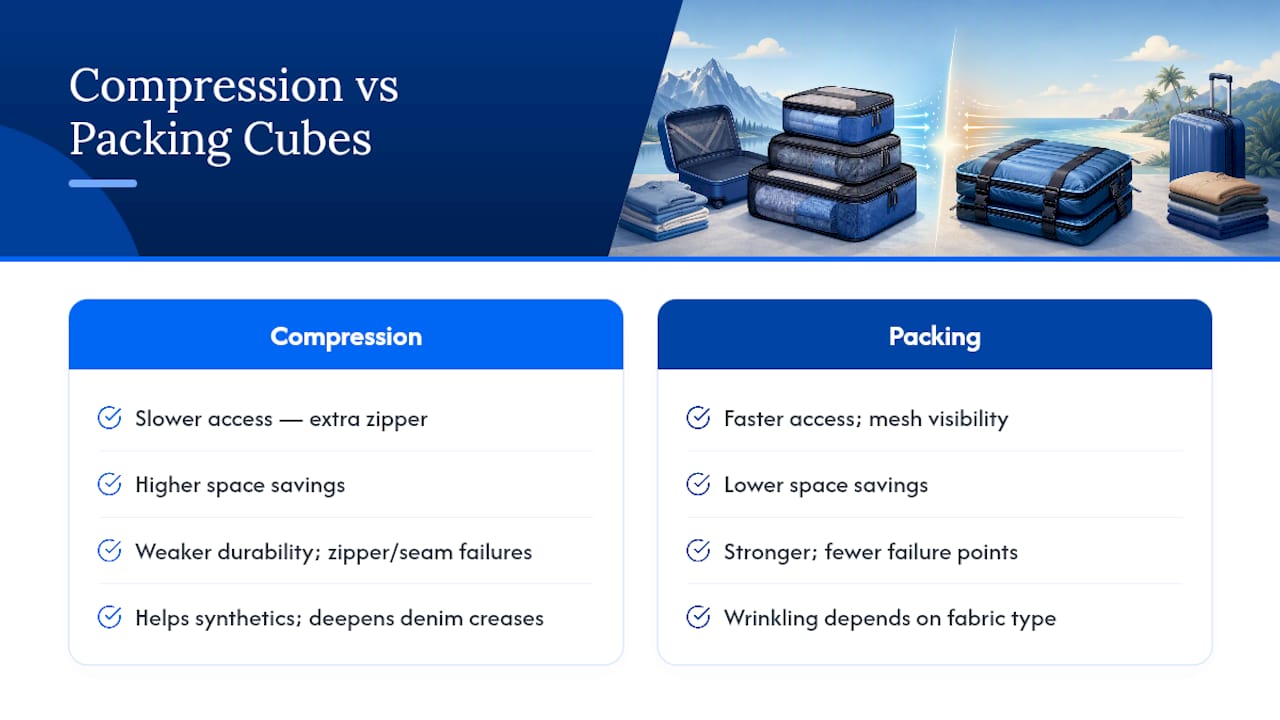
2. Space savings. Compression cubes win on volume. The compression mechanism, not the fabric container itself, is what primarily contributes to their space savings.
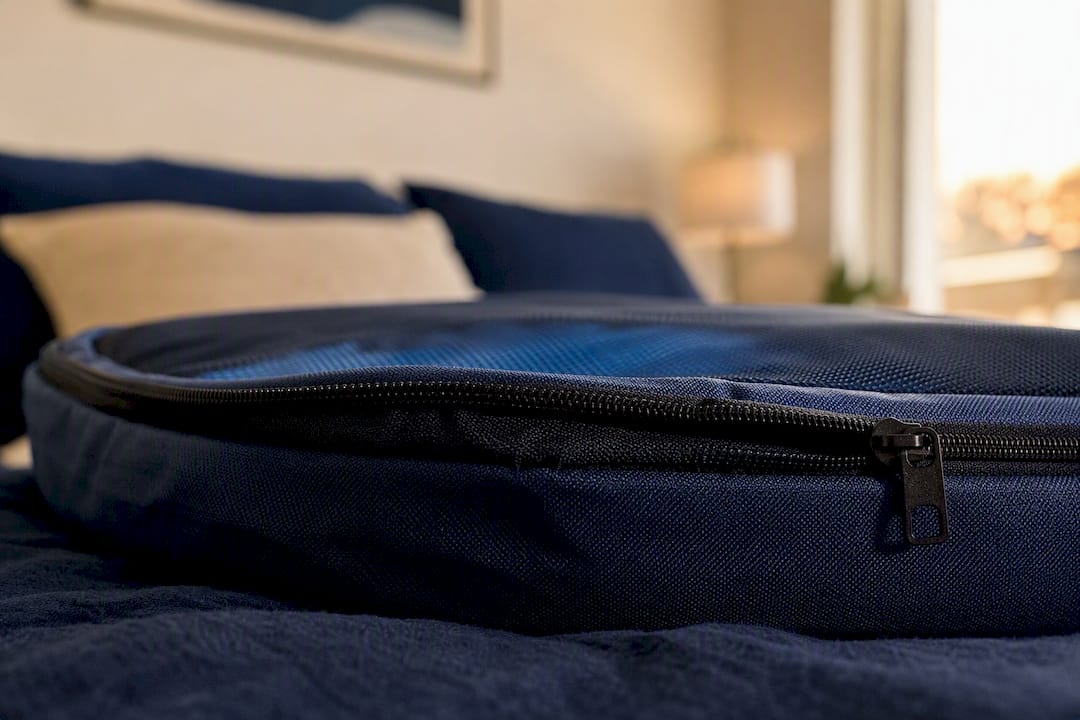
3. Durability. This is where compression cubes show their weak point. Testing across 26 packing cube sets over 14 trips found that zipper stress and seam wear are the most common failure modes, especially on cubes that get compressed to their absolute limit trip after trip. A double zipper under constant tension simply has more places to fail than a single one.
4. Wrinkling. Fabric type decides this more than the cube does. Compression works best on synthetics and knits; it does little for structured or heavy fabrics and can actually deepen creases in denim or fleece, according to long-term editorial testing at Travel + Leisure.
5. Weight. Compression cube sets typically weigh more than plain cube sets because of the extra hardware. For backpackers counting every ounce, that difference matters.
Pro Tip: Buy compression cubes with YKK or similarly reinforced zippers if you plan to compress on every trip. Cheap zippers are the first thing to fail under repeated stress.
How Do Compression and Packing Cubes Actually Work?
A standard packing cube is deliberately simple: one zipper, a mesh or clear top panel, and enough structure to hold its shape when you set it in your suitcase like a drawer. That structure is the whole point. It keeps a folded shirt from unraveling into the socks next to it.
Compression cubes start the same way, then add a mechanism to reduce volume after packing:
- Secondary zipper systems let you zip the cube shut normally, then zip a second seam that folds the cube flatter, physically expelling trapped air.
- Strap-and-buckle systems work like old-school sleeping bag straps, cinching the cube down after you’ve closed it.
- Material choice matters here. Ripstop nylon holds its shape and resists tearing under compression stress; mesh panels let you see contents but add no structure; clear vinyl panels offer visibility with slightly more rigidity.
The practical effect on packing sequence: compression cubes need to go in after you know roughly how much stuff you have, since you’re relying on air removal rather than folding density. Plain cubes, by contrast, slot into any luggage silhouette immediately because their shape doesn’t change once packed.
How Much Space Do Compression Cubes Really Save?
The numbers back up what most travelers suspect: compression cubes save meaningfully more space than plain cubes, but the gain depends heavily on what you’re packing.
Published test data puts compression cubes at roughly 20 to 30 percent volume savings for soft garments, compared with about 10 to 15 percent for plain cubes, which save space simply by forcing denser, more uniform folding. That gap sounds small on paper. In a 20-liter carry-on, it’s often the difference between fitting a week’s clothes and needing to check a bag.
Three factors swing that percentage in either direction:
- Fabric type. Compression is most effective when cubes are 70 to 90 percent full of pliable, synthetic fabric. Thick cotton and denim resist compression and hold onto wrinkles regardless of how hard you squeeze.
- Cube fullness. An underfilled compression cube has nothing to expel and barely outperforms a plain cube. Overfilled cubes stress the zipper without gaining much extra room.
- Zipper and seam durability. The same testing that measured space savings also flagged zippers and seams as the most likely failure points, particularly on cubes compressed near their maximum capacity trip after trip, per The Guardian’s testing.
If you’re comparing packing cubes vs vacuum bags directly, vacuum and roll-up valve bags outperform both cube types on raw volume, saving 30 to 75 percent depending on the system. That comes at a real cost: higher wrinkle risk, no mid-trip access without repacking the whole bag, and for vacuum bags specifically, dependence on a pump or an outlet to reseal once you’ve opened them.
The trade-off in one line: more compression almost always means less convenience. Where you land on that spectrum should match your trip, not your Instagram feed.
Which Should You Use for Your Trip?
1. Carry-on-only flights. Compression cubes typically tip the scale here because you’re optimizing for one thing: fitting everything into a bag that meets airline size limits. You’re not repacking daily, so the extra effort to compress each cube once at the start of the trip may be worth it.
2. Multi-stop or frequent repacking. Plain packing cubes usually win. If you’re checking out of a hotel every one or two nights, you need speed and visibility more than maximum density. Uncompressing and recompressing a cube every morning gets old fast.
3. Winter travel or bulky gear. This is where an integrated vacuum system starts to make more sense than cubes alone. Down jackets, sweaters, and bulky knits compress dramatically with a vacuum pump, more than either cube type can manage on its own.
4. Backpacking with a single pack. Weight matters more than volume here. Plain cubes, being lighter, often make more sense unless you’re truly maximizing a small pack for a long trip.
5. Family or multi-person packing. Organization outranks compression. Color-coded plain cubes, one shade per traveler, cut down on suitcase confusion faster than any compression mechanism will.
A small hybrid kit, two compression cubes paired with two plain cubes, covers most of these scenarios without overloading your luggage with hardware you don’t need.
Packing Techniques That Make Either Cube Type Work Better
Rolling and folding aren’t interchangeable techniques, and which one you use should match the cube type and the fabric.
Rolling works best in plain packing cubes for casual wear like t-shirts, leggings, and athletic gear. Rolled items pack tighter than folded ones without a compression mechanism doing the work, and rolling tends to minimize deep creases better than folding does.
Folding works better before compression. If you’re using a compression cube, fold garments flat first, then let the compression mechanism handle density. Rolling and then compressing can create odd pressure points that deepen wrinkles rather than smoothing them.
What compresses well: synthetics, activewear, knits, and most casual cotton. What to keep separate: structured blazers, suits, leather, and anything with stiff interfacing. These items hold their shape better folded flat in a garment sleeve or the top layer of your suitcase, away from compression entirely.
Layer heavier compression cubes at the bottom of your suitcase near the wheels, lighter plain cubes on top for easy access. A small toiletry organizer tucked into a side pocket keeps liquids away from clothing cubes entirely, which matters more than people expect after one leaking bottle ruins a shirt.
Pro Tip: Never compress a cube to its absolute zipper limit on the first day of a trip. Leave a little slack for souvenirs, or you’ll be sitting on your suitcase at the airport trying to force it shut.
What Does an Integrated Vacuum System Add Over Cubes?
Compression cubes cap out around 20 to 30 percent space savings because they rely on manual pressure or strap tension. An integrated vacuum system removes air actively with a pump instead, which is why Stoiq’s vacuum compression bags are built around a built-in USB-C rechargeable pump rather than straps or a second zipper.
The brand’s own data points to travelers packing 2 to 3 times more into a carry-on using this method compared with traditional folding. That’s a meaningfully bigger jump than compression cubes deliver, and it comes without needing a separate handheld vacuum, which most vacuum bag systems require.
The trade-off is real: you need battery charge in the pump, and heavily vacuum-sealed items can wrinkle more than loosely packed ones, similar to the wrinkle risk seen with any high-compression method. Where this approach earns its place:
- Packing a full carry-on for a week-long trip without checking a bag
- Compacting bulky sweaters or a jacket that would otherwise eat half your suitcase
- Avoiding checked-bag fees on a budget airline by fitting everything into carry-on limits
For readers who’ve decided compression cubes don’t save enough space for a specific trip, the Stoiq Compression Backpack applies the same vacuum principle in a bag built for travel rather than a standalone accessory.
What Actually Matters When You’re Deciding
Most packing advice treats this as a binary choice, cubes or compression, when the real question is what your trip actually demands. Carry-on-only travelers are optimizing for volume. Multi-stop travelers are optimizing for time. Those are different problems, and no single product solves both equally well.
Where I think the conventional advice falls short is in treating compression as a universal upgrade. It isn’t. Compressing a denim jacket to save two inches of space isn’t worth the wrinkles it creates, and testers have flagged this repeatedly. The fabric decides whether compression is worth the effort, not the marketing on the cube’s packaging.
If I had to prioritize one thing for readers to fix first, it’s this: stop assuming more compression is always better. Match the tool to the trip. Then, if your carry-on still won’t close after using compression cubes correctly, that’s the specific signal to look at a vacuum system instead of buying a third set of cubes and hoping.
Ready to Pack More Without Checking a Bag?
Compression cubes get you to 20 to 30 percent more space. If that’s still not enough to keep your carry-on under the limit, an integrated vacuum system is the next step up, and it’s the whole reason Stoiq built its bags around a pump instead of straps. No separate handheld vacuum to pack, no fumbling with a second zipper mid-trip, just a built-in USB-C rechargeable pump that does the compressing for you.
That matters most for the exact scenario this article keeps circling back to: carry-on-only flights where every cubic inch counts. The Stoiq Carry-On Solution 20L is built for that trip type specifically, and if you’re packing for two people or a longer haul, the Carry-On Bundle pairs the vacuum bag with a compression backpack for even more room. Over 20,000 travelers have used Stoiq bags to skip checked-bag fees entirely, and you can see what they say for yourself on the Stoiq reviews page. If your next trip is carry-on-only, start there before you buy another set of cubes.
Frequently Asked Questions
Are compression cubes worth it? For carry-on-only travel, yes. The 20 to 30 percent space savings they typically deliver can be the difference between fitting your bag under airline limits and paying a checked-bag fee. For trips where you repack daily, the extra effort and durability trade-offs make plain cubes the better call.
Are packing cubes better than rolling clothes with no cubes at all? Packing cubes generally beat freeform rolling for organization and modest density gains, since the cube structure keeps folded or rolled items compressed against each other rather than shifting loose in your suitcase.
Should I choose packing cubes or vacuum bags for a two-week trip? For a two-week trip, a hybrid approach usually works best: plain cubes for items you’ll access often, and a vacuum bag or compression cube for bulky items like sweaters that you won’t need until later in the trip.
Do compression bags or packing cubes cause more wrinkles? It depends on fabric. Compression bags and compression cubes both increase wrinkle risk on heavier fabrics like denim, while plain packing cubes tend to preserve garment shape better since nothing gets squeezed.
Can I use compression cubes and vacuum bags together? Yes, and many frequent travelers do exactly that: vacuum bags or an integrated vacuum system for bulky items like jackets, compression cubes for mid-weight garments, and plain cubes for anything you need quick access to during the trip.
Sources
- Packing Cubes vs Compression Bags vs Vacuum Bags: What Wins Where - 2026 Pack Lightly
- I tested 26 packing cubes on 14 trips – here are best ones to travel smarter | The Guardian
- Best packing cubes for travel — Travel + Leisure
- Packing Cubes vs Compression Bags: Which Is Better? – Mokobara
